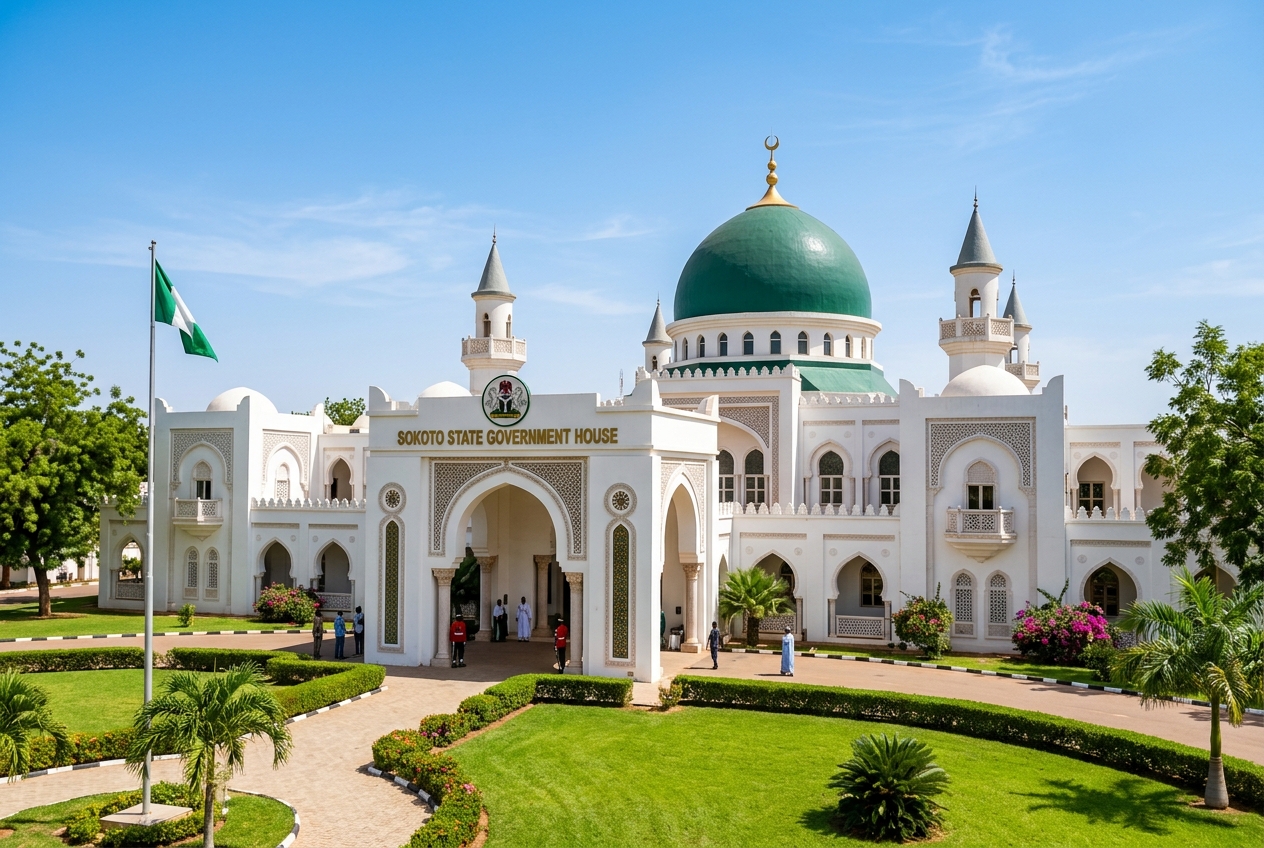
The Sokoto State Government is committed to inclusive development, good governance, and fostering the welfare, security, and economic prosperity of all citizens.
Sokoto State is located in the extreme North-West region of Nigeria, near the confluence of the Sokoto River and the Rima River. As the historic seat of the Sokoto Caliphate, it remains a major spiritual center for Islam in Nigeria.
The state is rich in cultural heritage, mineral deposits, and fertile agricultural soil, driving Governor Dr. Aliyu Ahmad's multi-sectoral transformation initiatives in education, economy, health, and security.
Exploring the geography, climate, vegetation, and natural beauty of Sokoto State
Geography & Location
Sokoto State is located in the extreme North-Western part of Nigeria, near the confluence of the Sokoto River and the Rima River. The state holds a strategic position as the historic seat of the Sokoto Caliphate and remains a major spiritual center for Islam in Nigeria.
With a land area of 28,232.37 square kilometers, Sokoto State is positioned between longitudes 11°30' to 13°50' East and latitude 4° to 6° North. This geographical positioning places the state within the tropical region of West Africa, characterized by distinct seasonal patterns.
Total Land Area
28,232.37 km²
Longitude
11°30' to 13°50' East
Latitude
4° to 6° North
Boundaries
Sokoto State shares borders with several regions:
North: Niger Republic, providing an international border that facilitates cross-border trade and cultural exchange
East: Zamfara State, sharing historical and cultural ties
South and West: Kebbi State, with which Sokoto shares the Rima River basin
Vegetation & Ecology
In terms of vegetation, the State falls within the savannah zone. This ecological zone is characterized by:
Open grassland with scattered trees and shrubs
Tsetse fly-free environment, making it suitable for livestock rearing
Fertile soil suitable for cultivation of grain crops
Natural pasture for animal husbandry
The savannah vegetation supports both agricultural activities and pastoral farming, making it one of the most productive agricultural regions in Northern Nigeria.
Climate & Weather Patterns
Sokoto State experiences a tropical climate with distinct wet and dry seasons. The rainfall pattern is characterized by:
Rainfall
Rainfall in Sokoto State starts late and ends early with mean annual falls ranging between 50mm to 1,300mm. The rainfall distribution is uneven, with the northern parts receiving less rainfall compared to the southern areas.
Seasons
There are two major seasons in the State:
Wet Season (May to September/October)
The wet season begins in most parts of the State in May and lasts up to September or October. During this period, the state experiences:
Moderate to heavy rainfall
Increased humidity levels
Greener vegetation and agricultural activities peak
Rivers and water bodies swell, supporting fishing and irrigation
Dry Season (October to April/June)
The dry season starts from October and lasts up to April in some parts but may extend to May or June in other parts. Characteristics include:
Little to no rainfall
Lower humidity levels
Harvesting of crops
Increased agricultural processing activities
Harmattan Period
The Harmattan, a dry, cold, and dusty wind is experienced in the State between November and February. This period is characterized by:
Cool, dry air from the Sahara Desert
Reduced visibility due to dust haze
Lower temperatures, especially during mornings and nights
Dry skin and chapped lips are common
Temperature Patterns
Heat is more severe in the State in March and April, with temperatures often reaching their peak. However, the weather in the State is always cold in the morning and hot in the afternoon except at the peak of harmattan. This diurnal temperature variation is a characteristic feature of the tropical savannah climate.
28,232 km²
Total Land Area
50-1,300mm
Annual Rainfall Range
2
Major Seasons
Nov-Feb
Harmattan Period
Natural Resources
The land of Sokoto State is endowed with numerous natural resources that contribute to its economic potential:
Fertile Agricultural Land: Suitable for growing grains, vegetables, and cash crops
Water Resources: Rivers, dams, and lakes that support irrigation and fishing
Mineral Deposits: Kaolin, gypsum, limestone, laterite, phosphate, and clay
Pasture Land: Tsetse-free grassland for livestock rearing
Major Water Bodies
Sokoto State is blessed with several water bodies that support agriculture, fishing, and domestic use:
Goronyo Dam: One of the largest irrigation dams in the region
Lugu Lake: Supporting fishing and irrigation activities
Kalmalo Lake: Another important water body for agriculture
Wamakko Lake: Providing water for farming communities
Kwakwazo Lake: Supporting both agriculture and fishing
Sokoto River: A major river flowing through the state
Rima River: Confluence with Sokoto River, forming a major water system
Strategic Importance
The geographical location of Sokoto State provides several strategic advantages:
International Border: Proximity to Niger Republic facilitates cross-border trade and cultural exchange
Agricultural Hub: Fertile land makes it one of Nigeria's major food-producing states
Historical Significance: As the seat of the Sokoto Caliphate, it holds immense historical and religious importance
Trade Corridor: The state serves as a trade link between Nigeria and West African countries
Cultural Center: Home to diverse ethnic groups and rich cultural heritage
People of Sokoto
Discover the rich cultural diversity, ethnic groups, and traditions of Sokoto State
Population Overview
According to the provisional figures of the 2006 National Population Census, Sokoto State has a population of 3,696,999 people. The population is predominantly rural, with most inhabitants engaged in agriculture and related activities.
The state's population has grown significantly since the 2006 census, with current estimates suggesting over 4.5 million people, reflecting a steady growth rate driven by high birth rates and improved healthcare services.
Population (2006 Census)
3,696,999
Major Ethnic Groups
Hausa & Fulani
Common Language
Hausa
Predominant Religion
Islam
Ethnic Groups
Sokoto State is home to a diverse population made up principally of two major ethnic groups:
1. Hausa People
The Hausa are the largest ethnic group in Sokoto State, comprising the majority of the population. They are known for their rich cultural heritage, entrepreneurial spirit, and strong Islamic traditions. The Hausa people in the State are made up of several sub-groups:
Gobirawa: Originally from the Gobir Kingdom, one of the ancient Hausa states
Zamfarawa: Originating from the Zamfara region, known for their warrior traditions
Kabawa: A group with roots in the Kebbi area, known for their fishing and farming skills
Adarawa: From the Adar region, known for their trade and commerce
Arawa: A group with historical ties to the Arawa people of the region
2. Fulani People
The Fulani are the second major ethnic group in Sokoto State. They are traditionally pastoralists but many have become settled farmers and traders. The Fulani in Sokoto are divided into two main groups:
A. Town Fulani (Settled)
Toronkawa: The clan of Shehu Usman Danfodiyo, the founder of the Sokoto Caliphate. This group represents the aristocratic class that has held political and religious authority since 1804.
Sullubawa: Known for their cultural refinement and Islamic scholarship
Zoramawa: A group known for their agricultural skills and settlement patterns
B. Nomadic Fulani (Pastoralists)
The nomadic Fulani continue to practice traditional pastoralism, moving with their cattle herds in search of water and pasture. They maintain their traditional way of life while also engaging in trade and commerce.
3. Minority Groups
There are also minority groups in the border Local Government Areas:
Zabarmawa: A group with roots in the Zabarma region, known for their trading networks
Tuareg: Nomadic pastoralists from the Sahara region, known for their distinctive culture and language
Other Nigerian tribes also live peacefully with the citizens of the State, devoid of any form of harassment or molestation. This peaceful co-existence reflects the state's tradition of tolerance and hospitality.
Language
All these groups speak Hausa as a common language, which serves as the lingua franca of the state. Fulfulde is spoken by the Fulani, particularly among the nomadic communities. English is also widely used in official and educational settings.
Culture & Traditions
Culturally, the State is homogenous, with Islam providing a unifying framework for social conduct and behavior. The culture of Sokoto State is a rich tapestry of Islamic traditions, Hausa-Fulani customs, and historical influences.
Religious Practices
The people of the State are predominantly Muslims and Islamic religion provides them with a code of conduct and behavior. Religious practices include:
Five daily prayers (Salah)
Fasting during the month of Ramadan
Giving of Zakat (charitable giving)
Pilgrimage to Mecca (Hajj) for those who can afford it
Festivals
Two major festivals are celebrated in the State every year:
Eid-el-Fitr
Marks the end of Ramadan fasting. This joyous celebration involves special prayers, feasting, gift-giving, and community gatherings. Families come together to celebrate the completion of a month of spiritual reflection and discipline.
Eid-el-Kabir
Features the slaughter of rams in commemoration of the act started by Prophet Ibrahim (Abraham) peace be unto him thousand years ago. This festival emphasizes sacrifice, charity, and obedience to God.
Traditional Sports & Entertainment
Sokoto State has a rich tradition of sports and entertainment:
Kokawa (Traditional Wrestling): A popular sport enjoyed by the Hausa people. Wrestlers compete in traditional matches that are major social events.
Dambe (Traditional Boxing): Another traditional sport enjoyed by the Hausa people. It involves boxing with one hand wrapped in cloth.
Shoro: A form of entertainment for the Fulani, involving traditional dances and performances.
Doro: Entertainment for the Sullubawa, featuring traditional music and dance.
The Durbar Festival
Important visitors to the State are usually treated to a Grand or mini-Durbar, an event involving the parade of heavily decorated horses and camels mounted by men in full Traditional Military and Cultural attires. The Durbar is a spectacular display of:
Colorful traditional attire and regalia
Elaborate horse and camel decorations
Traditional music and drumming
Display of traditional weapons and martial skills
Cultural pageantry and historical reenactments
Social Structure
The social structure of Sokoto State is influenced by both Islamic teachings and traditional customs:
Religious Leadership: The Sultan of Sokoto is the supreme religious leader, a position that dates back to the Sokoto Caliphate
Traditional Rulers: Emirs and chiefs who oversee local governance and cultural preservation
Scholars and Teachers: Islamic scholars (Mallams) who provide religious education and guidance
Community Elders: Respected members of the community who provide leadership and counsel
Cultural Preservation
The people of Sokoto State take pride in preserving their cultural heritage through:
Traditional festivals and ceremonies
Storytelling and oral traditions
Traditional crafts and arts
Islamic education and scholarship
Preservation of historical sites and monuments
3.7M+
Total Population (2006)
2
Major Ethnic Groups
2
Major Festivals
4+
Traditional Sports
Conclusion
The people of Sokoto State represent a rich tapestry of cultures, traditions, and ethnicities united by a common language, religion, and shared history. Their cultural heritage continues to thrive and evolve, making Sokoto one of the most culturally rich states in Nigeria.
Religion in Sokoto
Understanding the Islamic heritage, religious traditions, and the historical significance of the Sokoto Caliphate
Islamic Faith in Sokoto
The people of the State are predominantly Muslims and Islamic religion provides them with a code of conduct and behavior. Islam permeates every aspect of life in Sokoto, from daily routines to social interactions, governance, and cultural practices.
The Islamic faith in Sokoto follows the Sunni tradition, specifically the Maliki school of jurisprudence, which provides the framework for religious practices and legal interpretations.
Core Islamic Practices
The people of Sokoto adhere to the fundamental practices of Islam:
Shahada: The declaration of faith that there is no god but Allah and Muhammad is His messenger
Salah: Five daily prayers performed at dawn, noon, mid-afternoon, sunset, and evening
Zakat: Obligatory charitable giving calculated as a percentage of wealth
Sawm: Fasting during the month of Ramadan, from dawn to sunset
Hajj: Pilgrimage to Mecca, which every able Muslim is expected to perform once in their lifetime
Major Festivals
Two major festivals are celebrated in the State every year, bringing together communities in joyous celebration:
Eid-el-Fitr
Meaning: The Festival of Breaking the Fast
Marks the end of Ramadan fasting. This celebration involves:
Special congregational prayers at Eid grounds
Feasting and sharing meals with family and friends
Gift-giving, especially to children
Charitable giving (Zakat al-Fitr) to the poor
Visiting relatives and community members
Wearing new clothes and traditional attire
Eid-el-Kabir
Meaning: The Festival of Sacrifice
Features the slaughter of rams in commemoration of the act started by Prophet Ibrahim (Abraham) peace be unto him thousand years ago. This festival emphasizes:
Sacrifice of animals (rams, goats, cows) following the Eid prayers
Distribution of meat to family, friends, and the poor
Acts of charity and generosity
Community gatherings and celebrations
Remembrance of Ibrahim's willingness to sacrifice his son Ishmael
The Sokoto Caliphate
The Sokoto Caliphate (Arabic: ٱلْخِلَاْفَة ساكواتو, romanized: al-Khilāfah al-Sākwātu) was a Sunni Muslim caliphate in West Africa that holds immense historical and religious significance.
Founding & Establishment
The caliphate was founded by Usman dan Fodio in 1804 during the Fulani jihads. This movement emerged from the desire to purify Islamic practice and establish a just Islamic state in West Africa.
The caliphate arose after the Hausa King Yunfa attempted to assassinate Usman dan Fodio in 1802. In order to escape persecution, Usman and his followers migrated towards Gudu in February 1804. Usman's followers pledged allegiance to Usman as the Commander of the Faithful (Amīr al-Muʾminīn), marking the formal establishment of the caliphate.
Territorial Expansion
By 1808, the Sokoto Caliphate had gained control of several Nigerian states. Under the sixth caliph Ahmadu Rufai, the state reached its maximum extent, covering almost the entire West Africa. The boundaries of the caliphate encompassed territories that make up present-day:
Cameroon
Burkina Faso
Niger
Nigeria
Governance & Structure
Developed in the context of multiple independent Hausa Kingdoms, at its height, the caliphate linked over 30 different emirates and over 10 million people in the most powerful state in the region and one of the most significant empires in Africa in the nineteenth century.
The caliphate was a loose confederation of emirates that recognized the suzerainty of the Amir al-Mu'minin, the Sultan of Sokoto. Each emirate maintained its local governance while acknowledging the overall authority of the Sultan.
Economic Impact
The caliphate brought decades of economic growth throughout the region. It established:
Trade networks across West Africa
Agricultural development and irrigation systems
Educational institutions and learning centers
Administrative and legal frameworks
Cultural and religious cohesion
An estimated 1-2.5 million non-Muslim slaves were captured during the Fulani War. Slaves worked plantations but may also have been granted freedom conditional on conversion to Islam, reflecting the caliphate's approach to integrating conquered peoples.
Decline & Fall
In 1903, the twelfth and last caliph Attahiru was assassinated by the British forces, which led to the end of the caliphate. The caliphate was dissolved when the British and Germans conquered the area and annexed it into the newly established Northern Nigeria Protectorate and Kamerun respectively.
The Sultan's Legacy
Although European colonists abolished the political authority of the caliphate, the title of sultan was retained and remains an important religious position for Sunni Muslims in the region to the current day. The Sultan of Sokoto continues to be the spiritual leader of Nigerian Muslims, providing:
Religious guidance and leadership
Interfaith dialogue and reconciliation
Community development initiatives
Preservation of Islamic heritage
Promotion of peace and unity
Influence on West African Islam
Usman dan Fodio's jihad provided the inspiration for a series of related jihads in other parts of the Sudanian Savanna and the Sahel far beyond the borders of what is now Nigeria. These movements led to the foundation of Islamic states in the regions that would become:
Senegal - Influencing the development of Islamic states in the Futa Toro region
Mali - Contributing to the spread of Islam in the Niger River basin
Ivory Coast - Extending Islamic influence into the forest regions
Chad - Connecting with Islamic movements in the Lake Chad region
Central African Republic - Spreading Islamic influence into the interior
Sudan - Linking with Islamic movements in the Nile Valley
Religious Education & Scholarship
Sokoto State has a long tradition of Islamic scholarship and education:
Traditional Quranic Schools: Found in every community, teaching children to recite and memorize the Quran
Islamic Learning Centers: Institutions for advanced Islamic studies in theology, law, and jurisprudence
Scholarly Lineage: A tradition of Islamic scholars tracing their intellectual heritage back to Usman dan Fodio
Madrasa Education: Formal Islamic schools offering comprehensive religious education
Interfaith Relations
While Sokoto State is predominantly Muslim, it maintains a tradition of peaceful coexistence with followers of other faiths:
Respect for religious diversity
Peaceful dialogue between different faith communities
Shared cultural celebrations and traditions
Religious tolerance and mutual understanding
1804
Caliphate Founded
30+
Emirates in Caliphate
10M+
Population at Height
1903
Caliphate Ended
Conclusion
Religion in Sokoto State, particularly Islam, is not merely a system of belief but a comprehensive way of life that shapes the identity, culture, and social structure of its people. The legacy of the Sokoto Caliphate continues to influence religious, political, and social life in the region, making Sokoto one of the most important centers of Islamic learning and practice in West Africa.
The Economy of Sokoto
Exploring the economic potentials, agricultural wealth, natural resources, and investment opportunities in Sokoto State
Agricultural Sector
Agriculture forms the backbone of Sokoto State's economy, with over eighty percent (80%) of the inhabitants practicing one form of agriculture or the other. The state's favorable climate, fertile soil, and abundant water resources make it one of Nigeria's most productive agricultural regions.
Subsistence Crops
Subsistence farming is the primary occupation for most rural families, who produce food for their household consumption. The main subsistence crops include:
Millets: A drought-resistant cereal grain, staple food in the region
Guinea-corn (Sorghum): Used for food, animal feed, and brewing
Maize (Corn): A versatile crop used for food and animal feed
Rice: Grown in wetlands and irrigated areas, increasingly important as a staple
Potatoes: Both sweet potatoes and Irish potatoes are grown
Cassava: A tuber crop used for various food products
Groundnut (Peanuts): Grown for oil extraction and consumption
Beans: A protein-rich legume, important in local diets
Cash Crops
Cash crops are grown for commercial purposes, generating income for farmers and contributing to the state's economy:
Wheat: Grown during the dry season under irrigation, used for flour production
Cotton: A major cash crop used in the textile industry
Tobacco: Grown for cigarette and other tobacco products
Vegetables: Various vegetables grown for local consumption and export
Agricultural Support Infrastructure
The state government has invested significantly in agricultural infrastructure to support farmers:
Irrigation Systems: Goronyo Dam and other water bodies support all-year-round farming
Agricultural Extension Services: Providing technical support and training to farmers
Fertilizer Subsidies: Making farming inputs more affordable
Farm Machinery: Availability of tractors and equipment for mechanized farming
Rural Roads: Facilitating transportation of farm produce to markets
Natural Resources & Minerals
Sokoto State is equally endowed with natural and mineral resources that offer significant economic potential:
Mineral Deposits
Minerals available in the State in commercial quantities include:
Kaolin: Used in ceramics, paper coating, and pharmaceuticals
Gypsum: Used in cement production and soil conditioner
Limestone: Used in cement manufacturing and construction
Laterite: Used in road construction and building materials
Red Mills: Used in dyeing and pigment production
Phosphate: Used in fertilizer production
Yellow Clay: Used in pottery and ceramics
Green Clay: Used in cosmetics and pharmaceuticals
Sand: Used in construction and glass manufacturing
Water Resources
Major water bodies supporting economic activities include:
Goronyo Dam: One of the largest irrigation dams, supporting thousands of hectares of farmland
Lugu Lake: Supporting fishing and irrigation activities
Kalmalo Lake: Providing water for farming communities
Wamakko Lake: Supporting both agriculture and fishing
Kwakwazo Lake: Another important water body for agriculture and fishing
Sokoto River: A major water source for the region
Rima River: Confluence with Sokoto River, supporting diverse economic activities
Major Crops
Millet, Sorghum, Maize, Rice
Cash Crops
Wheat, Cotton, Tobacco, Vegetables
Minerals
Kaolin, Gypsum, Limestone, Phosphate
Water Bodies
5+ Major Lakes & 2 Rivers
Local Crafts & Industries
Traditional crafts and small-scale industries play a vital role in the economic life of the people:
Traditional Crafts
Blacksmithing: Production of tools, farm implements, and traditional items
Weaving: Traditional textile production using local materials
Dyeing: Traditional dyeing of cloth and textiles
Carving: Wood and calabash carving for household and decorative items
Leather Works: Production of leather goods, bags, and accessories
Fishing Industry
The State is one of the fish producing areas of the Country. A large number of people along the River basins engage in fishing activities. The fishing industry provides:
Employment for thousands of families
Fish for local consumption
Fish for processing and export
Fish by-products for various uses
Animal Husbandry
The Tsetse-free-open-grassland has made animal husbandry a very lucrative venture in the State. There are all kinds of animals both wild and domestic in the State.
Livestock Production
Sokoto ranks second in Livestock production in the country with animal population of well over eight (8) million. The livestock sector includes:
Cattle: Both Fulani and crossbreed cattle for meat and milk production
Sheep: Important for meat and wool production
Goats: Significant for meat and skin production
Camel: Important in the northern parts for transportation and milk
Donkeys: Used for transportation and farm work
Poultry: Chicken, guinea fowl, and other birds
Livestock Products
Meat production for consumption and export
Milk and dairy products
Leather and hides for the leather industry
Manure for organic farming
Animal by-products for various uses
Investment Opportunities
The availability of economic potentials in Sokoto State provide excellent investment opportunities, particularly in agro-allied industries.
Agro-Allied Industries
Industries that can be established using local raw materials include:
Flour Mills: Processing wheat, maize, and millet into flour
Tomato Processing: Processing tomatoes into paste, sauce, and juice
Sugar Refining: Processing sugar cane into refined sugar
Textiles: Cotton processing and textile manufacturing
Glue: Production from animal by-products
Tanning: Processing of leather and hides
Fish Canning: Processing fish for export and domestic consumption
Dairy: Milk processing and dairy product manufacturing
Mineral-Based Industries
Industries using mineral resources include:
Cement Production: Using limestone and other minerals
Ceramics: Using kaolin and clay deposits
Construction Materials: Using laterite, sand, and gypsum
Fertilizer Production: Using phosphate deposits
Glass Manufacturing: Using sand deposits
Other Investment Opportunities
Large-scale Farming: Using irrigation systems for commercial agriculture
Livestock Development: Modern livestock farms and processing facilities
Trade and Commerce: Taking advantage of Sokoto's location as a trade corridor
Transport and Logistics: Supporting the movement of agricultural products
Tourism: Developing historical and cultural tourism sites
Infrastructure & Development
The Sokoto State Government has invested in infrastructure to support economic development:
Power Supply
All 23 Local Government Headquarters in the State have been connected to the National grid, ensuring reliable power supply for industrial and commercial activities.
Transportation
Road network connecting all LGAs
Bridges and water crossings
Connecting routes to neighboring states and countries
Communication
Telecommunications network coverage
Internet infrastructure
Digital economy initiatives
80%
Population in Agriculture
8M+
Livestock Population
2nd
Largest Livestock Producer
23
LGAs on National Grid
Challenges & Opportunities
While Sokoto State has enormous economic potential, there are challenges to overcome:
Need for more investment in irrigation infrastructure
Limited industrial development
Need for skill development and technical training
Opportunities
Untapped agricultural potential
Rich mineral deposits awaiting exploitation
Strategic location for trade and commerce
Growing population as market and workforce
Government commitment to economic development
Future Outlook
The economic future of Sokoto State looks promising with ongoing development initiatives and investment opportunities. The state government's focus on:
Agricultural modernization
Industrial development
Infrastructure improvement
Human capital development
Private sector partnerships
These efforts are expected to transform Sokoto into a major economic hub in Northern Nigeria.

 Explore Sokoto